
Leadership
Leadership shapes everything.Leaders set the tone through their mindset, behaviors, choices, and the conditions they create.
Research-grounded leadership for healthier workplaces
Good leaders don’t just drive performance. They help people thrive.
Practical tools and learning experiences grounded in positive leadership, positive psychology, organizational scholarship, and health psychology.
The GLI approach
The way people are led shapes culture, relationships, stress, recovery, and the conditions people need to contribute at their best.
Leaders set the tone through their mindset, behaviors, choices, and the conditions they create.
Shared norms and everyday practices shape how people collaborate, communicate, and support one another.
Stress, support, relationships, and meaning influence physical health, mental well-being, energy, sleep, and resilience.
When people feel well and supported, they experience greater vitality, connection, growth, and purpose.
Healthy, flourishing people and teams support better results, innovation, satisfaction, and long-term success.
Stronger leadership builds healthier cultures. Healthier cultures support healthier, more flourishing people. Flourishing people sustain high performance, and the cycle begins again.
The Flourishing Chain™ is an original GLI synthesis informed by research across leadership, organizational culture, health psychology, flourishing, and sustainable performance.
How the evidence is used
GLI resources distinguish established findings from practical applications and original tools, so you can see the evidence behind each idea.
Research-supported principleDirectly grounded in established research findings.
Evidence-informed practiceA practical application drawn from relevant research.
Original GLI framework or toolA GLI synthesis or resource, clearly identified as original.
Free resources
Clear, practical resources for leaders who want to strengthen culture, support well-being, and make better leadership choices without losing the evidence.
Begin here
A practical introduction to six research-grounded domains of leadership, with one reflection tool and two evidence-based action ideas from each.
Get the free guideHealth
A plain-language look at how leadership conditions influence stress, recovery, and health.
Read the research briefLeadership
A focused reflection on the everyday conditions your leadership is creating for other people.
Begin the reflectionMeetings
Estimate the annual investment in one recurring meeting and see which meeting conditions may deserve closer attention.
Check a meetingMeetings
What research suggests about meeting overload, fragmented attention, and whether meetings earn the time they consume.
Read the Evidence CheckBurnout
What research suggests about individual coping, working conditions, and organizational responsibility.
Read the Evidence CheckEmployee Health
What research suggests about leadership behavior, working conditions, stress, recovery, and organizational responsibility.
Read the Evidence CheckAssessments and measures
A curated library of validated instruments, from the Hope Scale to team psychological safety, so you can measure flourishing with the same rigor you bring to any other leadership metric.
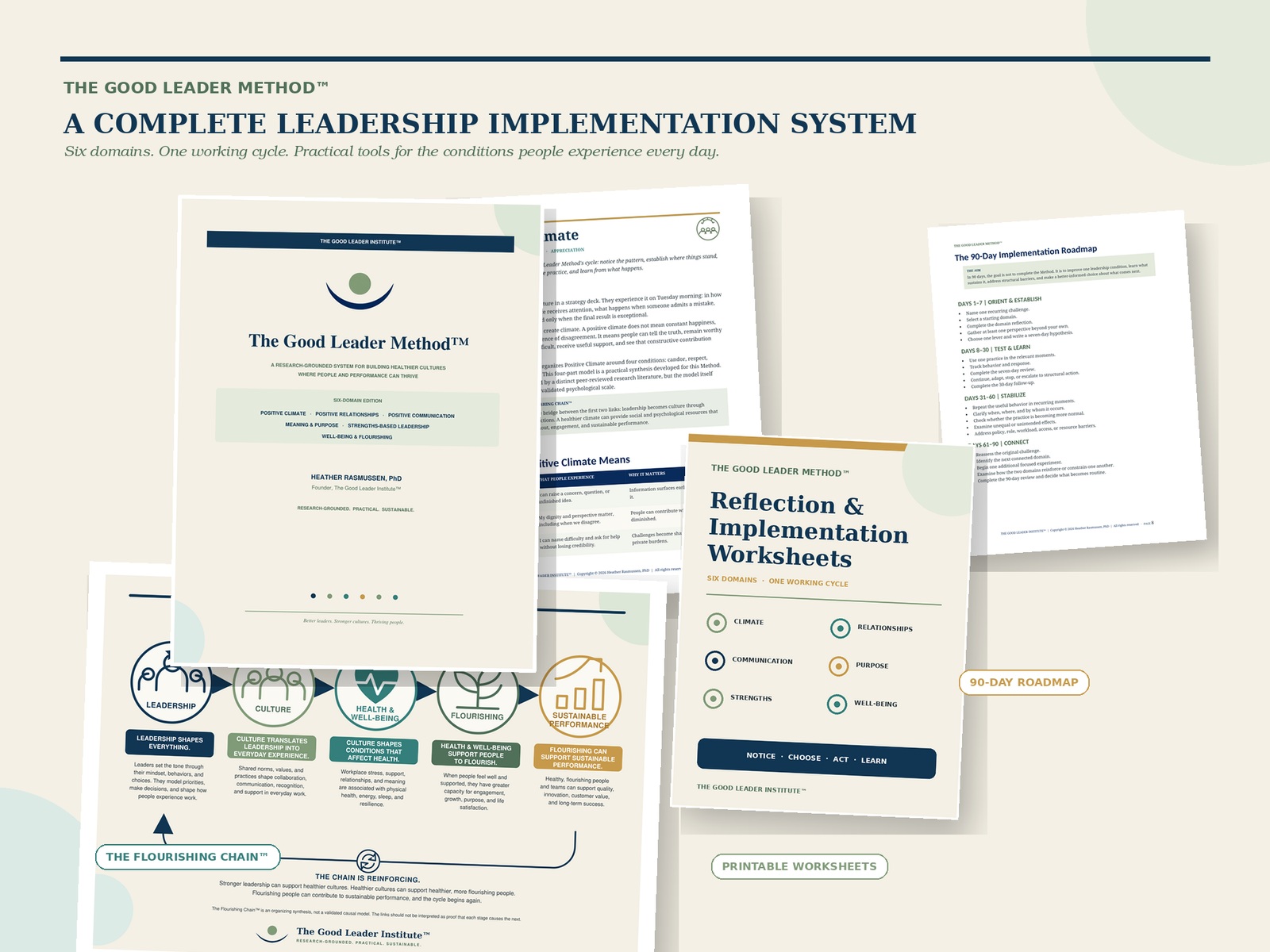
Six research-grounded domains, from positive climate to well-being and flourishing, each with tools you can use in a team meeting or a one-on-one conversation this week.
Complete leadership implementation system · Available now for $47
Practical micro-courses
Four connected courses that give leaders both the science and the tools to build environments where people genuinely thrive.
The first four courses move from diagnosing what goes wrong (burnout and stress) to defining what right looks like through flourishing and PERMA+4, understanding the conditions that make it possible through psychological safety, and developing the inner resources that sustain it through Psychological Capital.
Chronic workplace stress is often noticed only after health, energy, and performance have already deteriorated.
Leaders who want to recognize burnout earlier and create healthier conditions for themselves and their teams.
3–4 hours
Engagement scores alone cannot show whether people are genuinely flourishing or where leadership action is needed.
Leaders ready to measure well-being with rigor and turn data into practical team decisions.
3–4 hours
When people do not feel safe to speak, teams lose learning, surface fewer risks, and carry greater physiological strain.
Leaders who want candor and accountability without creating fear, silence, or lowered standards.
3–4 hours
Leaders and teams need developable inner resources to sustain performance, adapt, and grow through pressure.
Current and aspiring leaders who want to strengthen hope, efficacy, resilience, and optimism.
3–4 hours

About Dr. Heather Rasmussen
Dr. Heather Rasmussen is a leadership scholar-practitioner and licensed psychologist with over 25 years of experience translating psychological science into practical tools that help individuals and organizations thrive.
Her work sits at the intersection of positive psychology, leadership development, and organizational well-being, with a focus on helping leaders build cultures that support both performance and human flourishing.
Dr. Rasmussen has worked across diverse settings, including healthcare systems, Veterans Affairs, higher education, private practice, the service industry, and corporate environments, gaining deep insight into the challenges leaders face in complex organizations. She has spent over a decade as a professor of organizational leadership, where she developed an innovative doctoral-level specialization in positive leadership.
Through The Good Leader Institute™, she brings together her expertise in psychology, research, and leadership development to offer evidence-based, actionable strategies that help leaders create environments where people and performance can truly thrive.
“Workplaces can care for people while achieving meaningful results.”
A useful place to begin
A practical introduction to six research-grounded domains of leadership, with one reflection tool and two evidence-based action ideas from each.
Start a conversation
Have a question about GLI resources, courses, or future consulting? Send a brief message or reach out directly by email.
Email The Good Leader Institutehello@goodleaderinstitute.com